In honor of Juneteenth, I wanted to share a recipe that celebrates Black innovation, family traditions and the culinary contributions that have helped define American
food culture.
Many years ago, I was working in a kitchen alongside a friend of mine named Skinny. Like so many great food stories, this one didn’t begin in a dining room or at a chef’s table. It started in the dish pit.
One day, Skinny looked over at me and asked, “Hari, have you ever had white potato pie?”
At the time, I was a young chef, endlessly curious and always looking for a new ingredient, technique or story.
“No,” I told him. “I’ve never even heard of white potato pie.”
That answer surprised him.
He went on to explain that both of his grandmothers made it — one from Delaware and one from Baltimore. Each version was a little different, but both were treasured family recipes. It was one of his favorite desserts growing up.
The conversation stuck with me.
I’d heard of sweet potato pie, pumpkin pie, squash pie and countless other custard-style desserts made from root vegetables. But white potato pie was something entirely new. The more Skinny talked about it, the more intrigued I became.
So I started researching.
What I discovered was a regional specialty with deep roots in Delaware, Maryland and throughout the Eastern Shore. Like many traditional dishes, there was no single “correct” version. Families adapted the recipe based on what they had available. Some flavored it with warming spices similar to those in pumpkin pie. Others leaned into vanilla, lemon or nutmeg. The potato itself provided a wonderfully neutral canvas that could carry many different flavors while still maintaining its own subtle character.
What fascinated me most was the story behind it.
Food has a remarkable way of preserving history. Recipes are passed from grandparents to parents, from neighbors to friends, from one generation to the next. Sometimes they travel through cookbooks. More often, they travel through conversations.
Years later, when I was asked to contribute a Delaware recipe to *America: The Cookbook – A Culinary Road Trip Through the 50 States* by Gabrielle Langholtz (Phaidon, 2017), I thought back to that conversation with Skinny.
I submitted my Delaware Potato Pie recipe, inspired by the traditional white potato pies that had captured my imagination years earlier. It was eventually published as Delaware’s contribution to the cookbook.
I’ve continued to make the pie, tweak it and share this Delaware treat with friends and guests. Every time I bake one, I think about Skinny, his grandmothers and the generations of cooks who kept the tradition alive long before it found its way into a cookbook.
Juneteenth is a celebration of freedom, resilience and culture. It is also an opportunity to recognize the tremendous influence African American communities have had on the foods we eat every day. From farming traditions and preservation techniques to iconic dishes and regional specialties, Black culinary contributions are woven throughout the American table.
The truth is that African American food history is American food history.
You cannot separate the two.
Our nation’s cuisine was built by countless hands, stories and traditions. Many of those traditions deserve more recognition than they’ve historically received. Recipes like white potato pie remind us that some of the most important culinary treasures are not found in famous restaurants. They live in family kitchens, church cookbooks, handwritten recipe cards and memories shared between friends.
So this Juneteenth, I encourage you to make this pie.
Share it with your family. Tell the story behind it. Start a conversation.
Taste this piece of history.
And if it’s good enough for Skinny’s two grandmothers, it’s good enough for everybody.
Chef Hari Cameron’s Delaware Potato Pie
Adapted from the recipe published in America: The Cookbook by Gabrielle Langholtz (Phaidon, 2017)
This pie occupies a space somewhere between sweet potato pie, chess pie, and custard pie. The russet potatoes create a silky texture while bay leaf, vanilla, lemon, and nutmeg add layers of flavor that feel both familiar and uniquely Delmarva.
Makes 1 (9-inch) Pie | Serves 8
Ingredients
For the Potato Custard
- 3 medium russet potatoes (about 1½ pounds / 680 g)
- 1 cup (240 ml) heavy cream
- 1¼ cups (250 g) sugar
- ½ teaspoon kosher salt
- 3 fresh bay leaves
- 1 vanilla bean, split lengthwise
- ¾ teaspoon freshly grated nutmeg
- 3½ tablespoons (50 g) unsalted butter
- ¼ cup (60 g) sour cream
- ½ teaspoon fresh lemon juice
- 3 large egg whites
For the Pie Crust
- 3 large egg yolks
- ¼ cup (60 ml) heavy cream
- ½ cup (100 g) sugar
- 1 teaspoon kosher salt
- 1 cup (120 g) whole wheat flour
- 1 cup (135 g) bread flour
- ½ pound (230 g) cold butter, diced
Make the Custard
Place the potatoes in a pot and cover with cold water. Bring to a boil, reduce to a simmer, and cook until completely tender, about 25 minutes.
Drain, peel while still warm, and pass through a food mill, ricer, or mash until completely smooth. Allow to cool slightly.
In a saucepan, combine the cream, sugar, salt, bay leaves, vanilla bean, and nutmeg. Bring just to a simmer and cook gently for 15 minutes.
Remove from the heat and allow to steep another 15 minutes. Strain through a fine sieve.
Whisk the butter into the warm cream mixture until melted, then whisk in the sour cream and lemon juice.
Fold the cream mixture into the mashed potatoes until smooth.
In a separate bowl, whip the egg whites to stiff peaks. Gently fold the whipped whites into the potato mixture until just combined.
Set aside.
Make the Crust
Whisk together the egg yolks and cream.
In the bowl of a food processor, combine the sugar, salt, whole wheat flour, bread flour, and cold butter. Pulse until the mixture resembles coarse crumbs.
Slowly add the egg yolk mixture and pulse just until the dough comes together.
Turn onto a work surface, form into a disk, wrap, and refrigerate for at least 1 hour.
Roll the dough to about ⅛-inch thickness and fit into a 9-inch pie plate. Crimp the edges.
Line with parchment paper and pie weights and chill for 30 minutes.
Bake
Preheat the oven to 425°F (220°C).
Blind bake the crust until lightly golden, about 15–20 minutes.
Remove the parchment and weights. Allow the shell to cool slightly.
Reduce the oven temperature to 350°F (180°C).
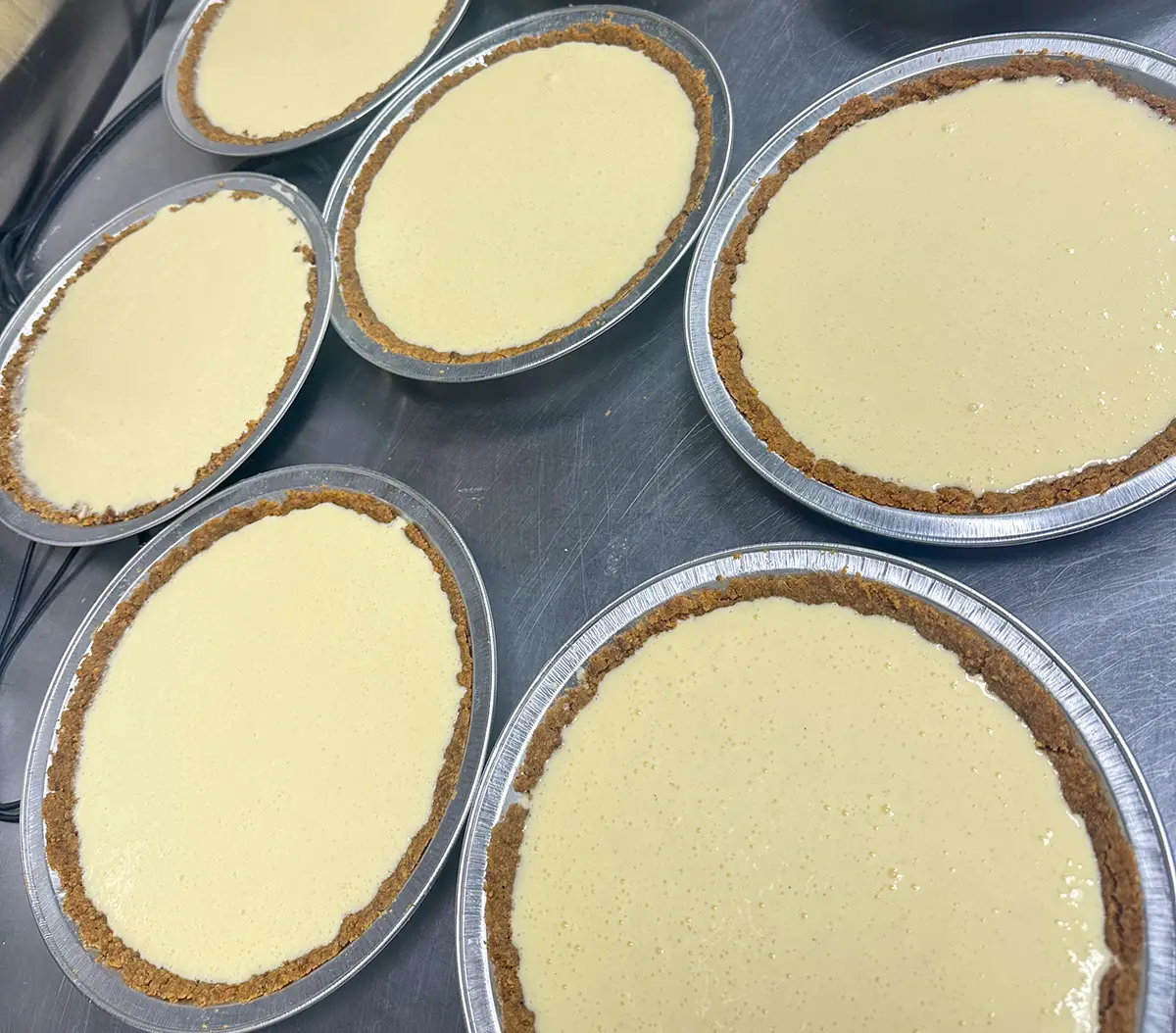
Pour the potato custard into the crust and bake until set and lightly browned, approximately 45–60 minutes.
The center should still have the slightest wobble when shaken.
Cool completely before slicing.
Chef’s Note
- White potato pie and Delaware potato pie share common roots in Mid-Atlantic culinary traditions and African American home cooking.
- The bay leaf is subtle but important—it adds a floral depth that makes this pie distinctive.
- I like to serve it slightly chilled with a scoop of peach ice cream or lightly sweetened whipped cream.
- Like many great family recipes, every household has its own version. Feel free to make it your own.